
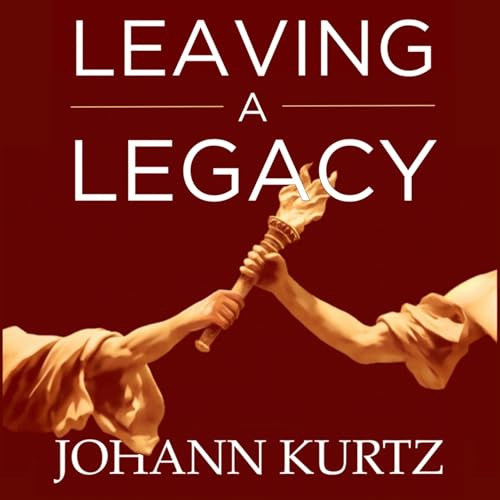
Leaving a Legacy
A few thoughts on Johann Kurtz

What legacy are you building?
What legacy will you leave?
Most people never seriously ask the question. Or if they do, it happens very late in life, usually while drafting a will.
That is the default setting of the modern world.
Earn. Accumulate. Die. Distribute.
In my first post on Johann Kurtz’s Leaving a Legacy, I explored one of his core observations: the modern custom of giving at death.
His framing stuck with me.
Giving at death is not a joyous act. It is an act of resignation.
That insight alone would have justified reading it.
Fortunately the book goes much deeper than that.
Though not always in the directions I expected.
The Core Ideas
At its heart, the book is trying to challenge several deeply embedded assumptions about modern life.
The modern idea of meritocracy.
The role of parents and extended families.
The nature of wealth itself.
Running through all of this is a call for something unfashionable in modern culture.
Stewardship. And low time preference behavior.
The question the author keeps returning to is simple but uncomfortable.
What does it mean to build something that lasts longer than you?
The Caveats
Before getting into the arguments themselves, a few qualifiers.
The intellectual foundation of the book is Christianity. Not lightly. Heavily.
At times the argument essentially becomes:
“There is only one way through. Steel yourself and align your will to God.”
Phrases like this appear frequently.
That will work for some readers. For others it will be a dealbreaker.
Personally I would have preferred more exploration of why the type of legacy he advocates might make sense even in a secular context.
Many of the traditions he praises likely emerged for practical reasons long before they were justified through theology.
Chesterton’s Fence is the lens I prefer here. When encountering customs from the past, first ask why they existed before deciding whether to keep or discard them.
The author does occasionally gesture in this direction, but usually indirectly.
For him the spiritual and the practical appear inseparable.
Another limitation is the evidence base. The book leans heavily on a handful of interesting historical anecdotes rather than large data sets.
This is very much a theory and philosophy book rather than an instruction manual.
My final caveat is that at times, particularly early in the book, it drifts into the black pill.
It is dangerously seductive to believe you live at the end of an era.
It makes you feel perceptive.
It makes you feel like part of a remnant.
It justifies withdrawal.
Look back two hundred years.
By nearly every measurable metric, life in the West is dramatically better.
Longer lifespans.
Less violence.
Lower infant mortality.
Greater access to knowledge.
More mobility.
We do not live in a dying civilization.
We live in a noisy one.
Challenging Meritocracy
One of the more interesting sections examines the modern obsession with merit.
Specifically, how we define it.
Today merit usually means one thing.
Economic productivity.
As the author writes:
“Where the merit criterion is now applied to an adult, it usually means a single factor: relative economic productivity. The best person for the job is the person we expect to generate the most capital in the role.”
This framing quietly reshapes what society rewards.
It rewards:
tolerance for inhuman working hours.
subservient and predictable personalities.
people willing to sacrifice youth for résumé building.
compliance over criticism.
In other words, the system slowly converts Man into Worker.
And that is not a destiny most parents would consciously choose for their children.
Yet we often engineer exactly that outcome.
Families, Institutions, and the Long View
Another recurring theme in the book is the importance of extended networks.
Not just nuclear families.
Generations interacting with each other.
Children growing up surrounded by grandparents, cousins, mentors, and traditions.
The author repeatedly points to the role of rituals in reinforcing identity and continuity.
Shared meals.
Family gatherings.
Formal rites of passage.
Small practices that remind individuals they are part of something older and larger than themselves.
Modern life tends to flatten these structures.
We are more mobile, more individualistic, and more disconnected from multi generational institutions.
That freedom has benefits.
But it may also come with hidden costs.
I will likely explore this in further depth in a future post…
Challenging Portable Wealth
One of the more provocative ideas in the book concerns inheritance itself.
The author argues that inheritance should be as illiquid as possible.
Not a pile of financial assets.
Instead it should take the form of things like land, enterprises, and art.
Objects that carry history.
Objects that require stewardship.
Objects that cannot simply be sold with a few clicks.
His argument is that purely portable wealth dissolves across generations because it carries no identity with it.
A family farm carries memory.
A family business carries responsibility.
A painting carries story.
A brokerage account carries… numbers.
Whether you agree or not, it is a fascinating way to think about wealth.
The author eventually attempts to summarize what he believes are the practices of “thousand year families.”
His list is surprisingly simple.
Never forget the normal practices and rituals of raising healthy children.
Ensure that your family has a strong faith and knows duties as well as privileges.
Impress upon your children your family’s identity, mission, and values.
Initiate children into structures beyond the atomic family.
None of these ideas are particularly exotic.
Strong families. Clear expectations. Shared belief systems. Institutions that extend beyond the household.
But they raise an obvious question.
If these are truly the “secrets” of enduring families, why did so many branches of the same dynasties disappear?
History is full of powerful families that vanished within a generation or two.
Which suggests the formula, if one exists, is far more fragile than the list implies.
The Missing Piece
Is a legacy measured in money passed on?
Land preserved?
Children raised?
Art created?
Institutions built?
All of the above?
None of the above?
At some level the question may simply be too large.
We want a scoreboard.
Life rarely provides one.
The Real Value of the Book
It explores a topic that is strangely neglected.
Most financial writing focuses on accumulation. Occasional posts about the importance of a will.
Very little focuses on stewardship across generations.
And even less asks the deeper question.
What exactly are we trying to preserve?
The book does not provide a clean answer.
I wish it did.
Life would be a lot easier if someone could just hand us the scoring system.
But perhaps that uncertainty is the point.
Legacy is not a formula.
It is a question each generation has to answer for itself.
One thing neither the book or myself explore at length, is why leaving a legacy is desirable.
What does legacy mean to you? Are you actively seeking to establish one?