
Thinking Out Loud About Value-for-Value
and the Economics of Bitcoin Culture

This is not a complaint post.
It’s not entitlement.
It’s not a call for pity or donations.
More creators need to: lay out the numbers, the models, and the tradeoffs honestly, so those coming next can make better decisions.
This is that post.
The Value-for-Value Idea
Value-for-value is a clean concept:
Create something valuable. People who find value reciprocate voluntarily.
Bitcoin rails (Lightning, Nostr, Fountain, Geyser) make this easy.
In theory, it’s elegant. In practice, the economics are more complicated.
This isn’t fringe thinking.
It’s a central belief in the V4V movement - especially in Bitcoin circles.
And it’s a powerful idea:
No coercion
No surveillance
No middlemen
No artificial scarcity
The question isn’t whether the idea is good.
The question is whether it currently works at scale for high-effort Bitcoin culture.
Our Experience So Far (MotBC)
Project: Mysteries of the Bitcoin Citadel
Format: Audio drama podcast
Time active: ~1 year
Rough numbers
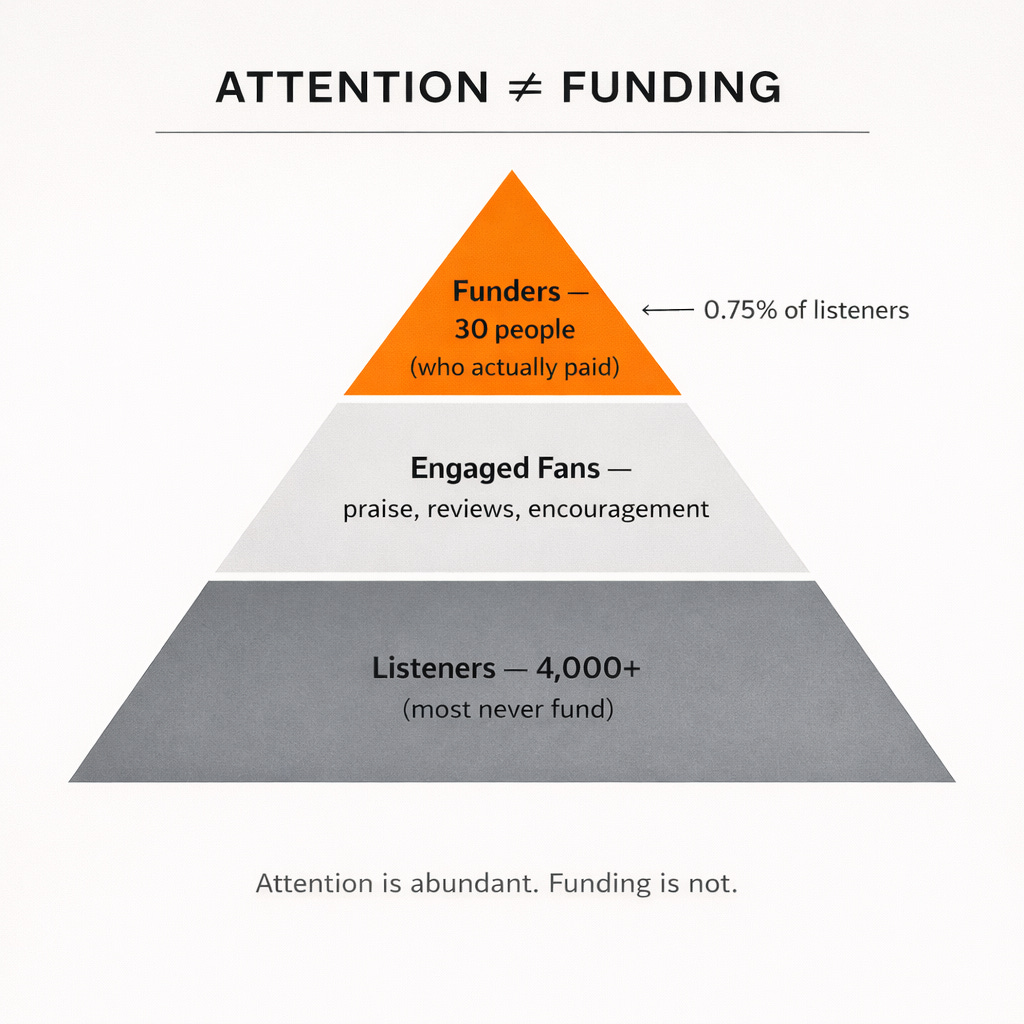
~4,000 total listens
~30 donors (Fountain + Nostr)
~100,000 sats total (~$100 at the time)
≈ 0.025 sats per listen
That’s the raw, unfiltered outcome of value-for-value so far.
What If We Used Ads or Sponsors?
Just to ground expectations, let’s compare against more familiar models.
Platform ads (rough range)
~$0.01–$0.15 per listen (assuming eligibility + scale)
Host-read ads / sponsors
Harder to estimate
Niche audience helps
Could plausibly match ads or maybe 2× ads at best
None of this is guaranteed, but it gives us a sanity check.
Value-for-Value Isn’t the Only Pricing Model
Before we moralize anything, let’s step back.
There are three core ways products get priced, whether people realize it or not.
1. Cost-Plus Pricing
Core Question
What does it cost me to make this?
Formula
Price = Cost + Margin
Inputs Considered
Production costs
Labor
Tools & software
Hosting & distribution
Time spent
Where It Commonly Appears
Manufacturing
Retail
Accounting-driven businesses
“I don’t want to think about pricing” businesses
Why People Use It
Feels fair and rational
Easy to calculate
Internally defensible
Primary Failure Mode
Customers don’t care about your costs
Guarantees underpricing when value is outsized
Tell-Tale Creator Thought
“I’ve spent thousands of hours on this…”
Emotionally true.
Economically irrelevant.
2. Market / Competitive Pricing
Core Question
What does the market expect this to cost?
Formula
Price = Category Norm ± Positioning
Inputs Considered
Competitor pricing
Category averages
Tier expectations
Where It Commonly Appears
SaaS products
Agencies
Apps
Subscription services
Why People Use It
Customers understand it immediately
Signals legitimacy
Reduces pricing friction
Primary Failure Mode
Inherits the market’s bad assumptions
Forces competition on features instead of outcomes
Tell-Tale Creator Thought
“I don’t want to price myself out of the category.”
If the category is underpriced, you will be too.
3. Value-Based Pricing
Core Question
What is this worth to the customer?
Formula
Price = Fraction of Value Delivered
Inputs Considered
Revenue unlocked
Costs saved
Risk avoided
Time reclaimed
Where It Commonly Appears
Consulting
Coaching
High-leverage B2B services
Why People Use It
Decouples price from effort
Rewards leverage over hours
Enables small teams to charge meaningful fees
Primary Failure Mode
Requires deep understanding of customer economics
Customers often don’t know the value themselves
Tell-Tale Creator Thought
“If I make them $100k, charging $10k is obvious.”
This breaks down when value is diffuse, long-term, or cultural - which is why most Bitcoin culture projects cannot use this model directly.
Which brings us back to value-for-value.
Ways Bitcoin Content Gets Funded (Rough Map)
None of these are “pure.” Most projects mix them.
Cost-based
Kickstarter / Geyser (all-or-nothing)
Pre-funding to hit a target margin
Market-based
CPM ads
Sponsor slots priced to category norms
Result-based
Referral links
Performance-based sponsorships
Faith-based
Pure value-for-value
“Field of dreams” economics
Create → hope → repeat
Each has tradeoffs. None are magic.
Reverse-Engineering MotBC (Uncomfortable Math)
Let’s do something most creators avoid.
Assume:
Target: $1,000 per episode
Episodes: 12
Total target: $12,000
Using our current donation rate:
~$100 per 4,000 listens
To hit $12,000:
~480,000 listens total
~40,000 listens per episode
Even if donations scaled linearly (they probably don’t).
So the question becomes:
Is it realistic for a Bitcoin fiction podcast to get that reach?
And if it did… earning $12k total still wouldn’t be life-changing. It wouldn’t even be self-sustaining…
“Maybe We Just Made a Bad Product”
This has to be acknowledged.
That’s always possible.
The only counter-arguments we have:
Strong listener reviews
Direct feedback from people who do find it
The absence of many wildly successful Bitcoin fiction projects (Movies, Books or TV Shows)
Which leads to a broader observation.
The Bitcoin Culture Market Is Still Tiny
Look around.
Ignoring events, the list is short:
A small number of fiction books
What’s a “successful” Bitcoin fiction book?
10,000 copies would be shocking
1,000 copies might put you near the top
Even at $12 per book:
That’s ~$12,000 gross
Before time, taxes, opportunity cost
This isn’t a moral failure.
It’s just the market.
The Uncomfortable Conclusion
Right now:
Bitcoin culture is early
The audience is small
The economics do not yet support full-time creators
Not without extreme outliers or cross-subsidization
Either:
The market must grow dramatically
Or the monetization model must change
Or creators must accept negative or near-zero ROI for years
Measured purely in sats, betting on Bitcoin fiction today is:
a worse gamble than betting on the Maple Leafs to win the Cup.
(And that hurts to say.)
Where That Leaves Us
We’re long Bitcoin culture.
We’re mostly low-time-preference people.
We’ll keep experimenting.
But we’re doing it eyes wide open.
If this becomes self-sustaining, we will be:
Rare
Early
Lucky
Or some combination of all three
And if it doesn’t?
At least the next group will have better numbers than we did.
That, in itself, might still be value.
What do you think?
I think some of the biggest things left to be asked from this article are:
1. Can this existing audience be better mobilized for support?
2. Is there a different audience/niche of Bitcoiners that should be targeted?
3. Do these sort of projects just need to work on their own, and have the Bitcoin angle be a bonus vs the primary focus?
4. How much prompting the audience for support with a V4V model is appropriate? When is it too much begging?